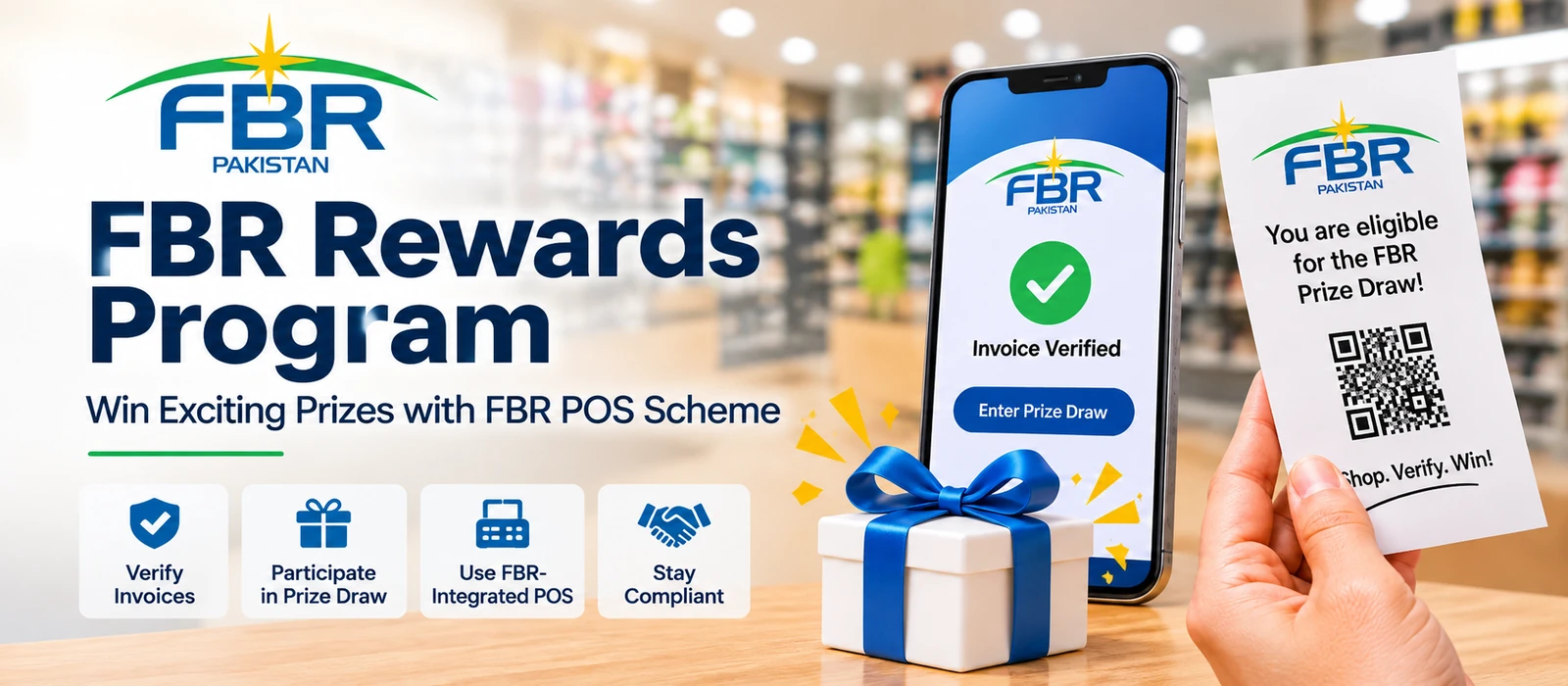

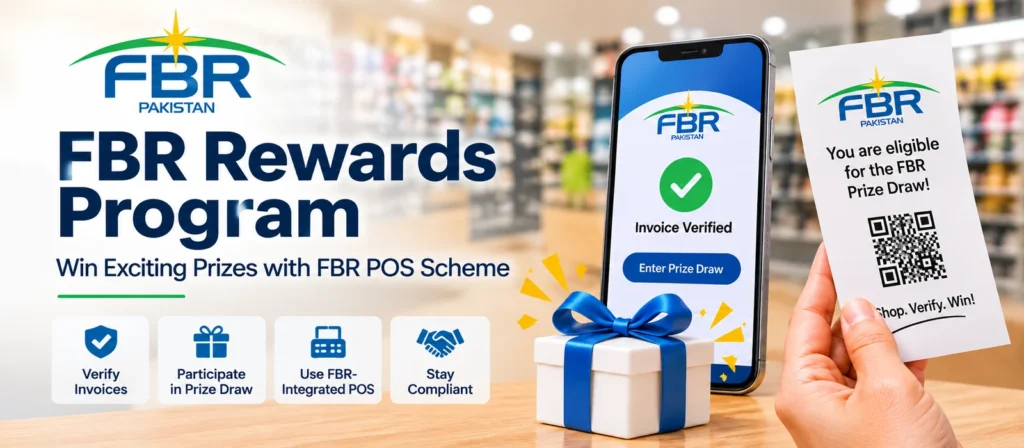
A rewards program can mean different things depending on who is offering the incentives. In Pakistan, customers may come across the Federal Board of Revenue’s (FBR) POS Prize Scheme, while retailers use their own loyalty programs to encourage shoppers to return and spend more.
Although both initiatives involve rewards, their purposes are quite different. The FBR Rewards Program is associated with the government’s efforts to encourage transparent retail transactions, promote invoice verification, and discourage businesses from issuing unverified sales receipts. On the other hand, a retailer’s rewards program is a customer-retention strategy that offers points, discounts, cashback, or complimentary products in exchange for repeat purchases.
For businesses operating in Pakistan, understanding these arrangements is particularly important as digital invoicing and POS integration become increasingly relevant to retail operations.
In this guide, we explore how the FBR POS Prize Scheme works, how customers can verify their invoices, what retailers need to know about FBR integration, and how businesses can introduce their own customer rewards programs using POS software.
What Is a Rewards Program?
A rewards program is an incentive-based arrangement designed to encourage a particular behaviour, such as shopping regularly, purchasing from participating retailers, or verifying sales invoices.
In Pakistan, the term can refer to two different arrangements.
1. Government-backed rewards initiatives
The FBR POS Prize Scheme is intended to encourage consumers to participate in documenting retail transactions. It connects invoice verification and reporting of unverified invoices with the possibility of receiving prizes under the applicable rules.
2. Retailer-operated customer loyalty programs
These are promotional arrangements created by individual businesses. Retailers reward customers for their continued purchases through points, cashback, discounts, membership benefits, or complimentary products.
For example, a supermarket might award points against every eligible purchase, while a clothing outlet could offer exclusive discounts to returning customers. Both approaches involve incentives, but their administration, eligibility requirements, and commercial objectives differ.
What Is the FBR Rewards Program in Pakistan?
When people search for the FBR Rewards Program, they are often referring to the Federal Board of Revenue’s Point of Sale (POS) Prize Scheme. The initiative was introduced to encourage consumers to shop at FBR-integrated Tier-1 retail outlets and participate in documenting sales transactions.
The original scheme, introduced under the Finance Act 2021, used invoice verification and computerized prize draws to encourage shoppers to request electronically generated receipts from integrated retailers.
However, the prize-scheme procedure was subsequently amended through S.R.O. 1513(I)/2024, dated September 26, 2024. Under the amended procedure, customers of integrated Tier-1 retailers who report unverified invoices may become entitled to prizes in respect of their purchases, subject to the applicable requirements and verification process.
This distinction matters. The current amended rules should not be confused with the original arrangement in which verified invoices were entered into a monthly computerized draw. The broader objective remains encouraging transparent transactions, discouraging false invoicing, and strengthening documentation of retail sales.
How Does the FBR POS Prize Scheme Work?
The scheme connects customers, integrated retailers, and FBR’s computerized invoicing infrastructure. Here is how the process works.
1. Purchase Products from an FBR-Integrated Retailer
Customers should request an electronically generated sales invoice when purchasing from an eligible Tier-1 retailer integrated with FBR’s POS system. Such invoices contain transaction information that can be checked through the prescribed verification mechanism.
2. Check the Invoice Details
Customers can use FBR’s published POS invoice verification instructions to check whether their purchase has been recorded. According to FBR’s published guidance, invoice verification can be performed through the Tax Asaan application by opening the FBR POS menu, selecting Verify Invoice, and entering the FBR invoice number or scanning the QR code printed on the receipt. FBR’s published page also describes an SMS verification method using the number 9966. Visit the official FBR POS Invoice Verification page for the published instructions.
3. Identify an Unverified Invoice
If the verification process identifies an invoice as unverified, customers can follow the reporting procedure prescribed under the applicable rules. The amended prize-scheme provisions provide for reporting unverified invoices through the application or a WhatsApp number to be communicated through an FBR order.
4. Submit the Required Information
Under the amended rules, customers reporting unverified invoices must provide the prescribed information, including:
- Customer’s full name.
- CNIC number.
- Registered mobile number.
- IBAN or bank account information.
- Proof of digital payment.
- Photograph of the unverified invoice.
- GPS-tagged photograph of the business premises that issued the invoice.
An important condition is that proof of digital payment must be provided. The amended rules state that failure to provide it results in forfeiture of the right to claim the prize.
5. FBR Reviews the Report
After a report is submitted, an alert is generated in the relevant Commissioner’s IRIS login for authentication of the unverified invoice. The authorities examine the submitted information to establish whether the customer’s claim qualifies under the applicable rules. The total prize money and prize denominations are determined by FBR.
Important: Reporting an unverified invoice does not automatically guarantee a reward. Eligibility, verification, and prize entitlement remain subject to FBR’s applicable procedure. Always consult the latest official instructions before submitting a claim.
What Is the Difference Between FBR Rewards and Retailer Rewards Programs?
Although both arrangements use incentives, they serve different purposes.
| Comparison | FBR POS Prize Scheme | Retailer Rewards Program |
|---|---|---|
| Managed by | Federal Board of Revenue | Individual business |
| Main objective | Encourage invoice documentation and reporting | Improve customer retention |
| Participants | Eligible customers of integrated Tier-1 retailers | Registered or eligible customers |
| Incentive | Prizes under applicable FBR rules | Points, discounts, cashback or gifts |
| Administration | FBR’s prescribed procedures | Retailer’s own policies |
| Technology | FBR POS and invoice verification infrastructure | POS or customer loyalty software |
A retailer should not advertise its own discount scheme as an official FBR rewards program. Likewise, participation in FBR’s prize scheme does not automatically mean that a retailer is offering customer loyalty points.
What Should Retailers Know About FBR POS Integration?
For eligible businesses, FBR POS integration is more than a billing convenience. It is an important part of the prescribed digital sales reporting framework. Tier-1 retailers required to integrate their outlets must use an appropriate system to transmit sales information to FBR according to the applicable requirements. A properly configured POS solution helps businesses organise their billing operations and maintain consistent transaction records. Here are some important considerations.
1.Real-Time Electronic Invoice Reporting
An integrated POS system transmits the prescribed sales invoice information to FBR’s computerized system. Retailers should ensure that their software is configured correctly and that invoices are generated according to the applicable requirements.
2.QR-Coded Sales Receipts
Electronic invoices generated through integrated systems contain information that helps customers verify their transactions. Retailers should ensure that their billing process generates the required invoice details rather than relying on ordinary handwritten receipts.
3.Accurate Sales Records
Every transaction should be recorded correctly, including relevant product details, quantities, prices, and applicable taxes. Organized records make it easier to review business activity and maintain consistency between sales transactions and accounting information.
4.Reliable POS Software
Retailers need software that supports their operational requirements while meeting applicable integration and invoicing obligations. Before choosing a provider, businesses should examine its integration capabilities, billing functions, technical support, and reporting features.
How Can Retailers Introduce Their Own Customer Rewards Program?
Apart from government initiatives, businesses can establish independent loyalty arrangements to encourage customers to purchase regularly. A well-designed customer rewards program can help retailers build stronger relationships without depending entirely on price reductions or advertising campaigns. Here are four practical models.
1. Points-Based Rewards
Customers accumulate points according to their eligible spending. For example, a retailer might offer one point for every Rs. 100 spent. Once a customer accumulates 500 points, they could redeem them for a Rs. 500 discount. This arrangement works well for supermarkets, pharmacies, grocery stores, and general retailers.
2. Cashback Incentives
Under this arrangement, customers receive a percentage of their purchase value as redeemable store credit. For example, a shop offering 2% cashback would provide Rs. 200 in store credit against an eligible purchase worth Rs. 10,000. The customer can use that balance towards a subsequent purchase according to the retailer’s redemption conditions.
3. Membership-Based Rewards
Businesses can introduce Silver, Gold, and Platinum membership categories. Customers may qualify for higher membership levels according to their purchasing activity and receive additional benefits. This structure is particularly useful for clothing outlets, electronics stores, furniture retailers, and businesses with regular high-value customers.
4. Purchase-Based Rewards
This is one of the simplest arrangements. For example, a bakery might offer a complimentary product after ten qualifying purchases, while a salon could provide a discounted service after several appointments. The conditions are straightforward, making this approach suitable for smaller businesses.
How POS Software Helps Manage a Rewards Program
Running a customer loyalty scheme manually can become difficult when a business serves hundreds of regular shoppers. Cashiers may struggle to calculate points, maintain customer balances, and verify previous transactions. POS software provides a more organized way to handle these activities. Depending on the available software features, retailers can use a digital system to:
- Register customer information.
- Record eligible sales transactions.
- Calculate reward points.
- Monitor customer purchasing activity.
- Manage discounts and promotional offers.
- Maintain customer transaction histories.
- Generate sales and business performance reports.
More importantly, an integrated POS and ERP solution can bring sales, inventory, accounting, and invoicing operations together. For businesses that must comply with FBR requirements, it is particularly useful to select software that supports the relevant integration and electronic invoicing requirements. A rewards program and FBR integration are separate functions, but both can form part of a retailer’s wider digital business management strategy.
How Sada Hisab Supports Retailers with POS and Digital Invoicing
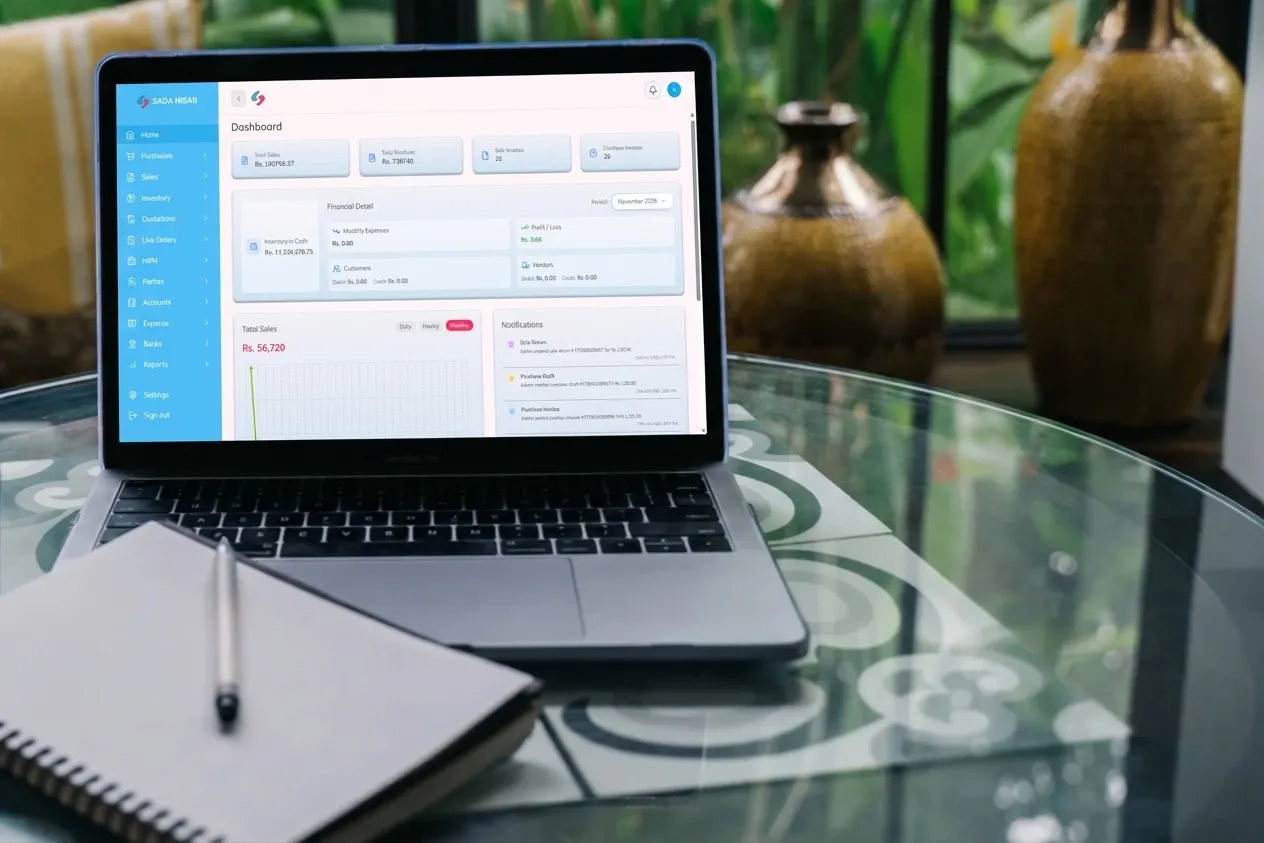
Managing everyday sales, inventory, accounts, and tax-related invoicing becomes increasingly demanding as a retail business expands. Sada Hisab provides POS and ERP software designed to help Pakistani businesses organize these essential operations through a centralized platform. With FBR and PRA integration capabilities, Sada Hisab helps eligible businesses manage their invoicing requirements alongside everyday retail activities.
Its business management capabilities include:
- POS billing and sales management.
- FBR-integrated digital invoicing.
- PRA digital invoicing integration.
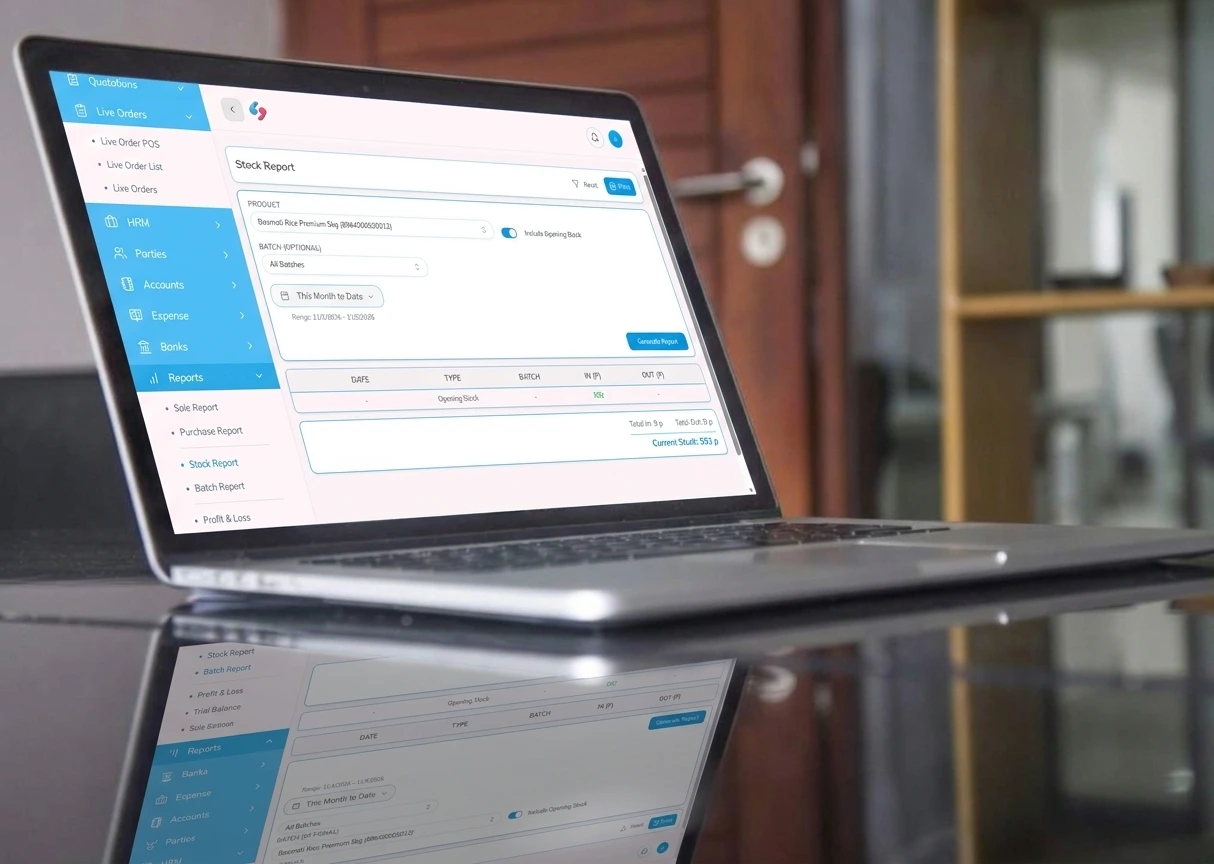
- Inventory and stock management.
- Accounting and financial reporting.
- Multi-branch business management.
- Customer and transaction records.
- Sales analysis and profit and loss reporting.
For retailers interested in introducing their own loyalty arrangements, a properly organized customer and transaction database can also provide a useful foundation. Specific reward-point or cashback functionality should be confirmed against the selected software package.
Whether you operate a supermarket, clothing store, pharmacy, restaurant, or another retail establishment, choosing appropriate POS software can help bring greater order to daily business activities. Explore Sada Hisab POS and ERP software to learn more about its FBR and PRA integration capabilities.
Conclusion
A rewards program can serve different purposes in Pakistan, from encouraging transparent retail transactions through government-backed initiatives to strengthening relationships between businesses and their customers.
The FBR POS Prize Scheme highlights the importance of invoice verification and reporting unverified transactions. Meanwhile, retailer-operated loyalty programs provide another way to encourage repeat purchases and improve customer retention.
For retailers, the two subjects connect through a broader shift towards organized, technology-driven business operations. Choosing reliable POS software, maintaining accurate transaction records, and understanding digital invoicing requirements can help businesses manage their operations more effectively.
Looking for POS software with FBR and PRA integration?
Discover how Sada Hisab can help organize your billing, inventory, accounting, and digital invoicing operations. Visit Sada Hisab or book a free demonstration to explore the platform and find a suitable solution for your business.