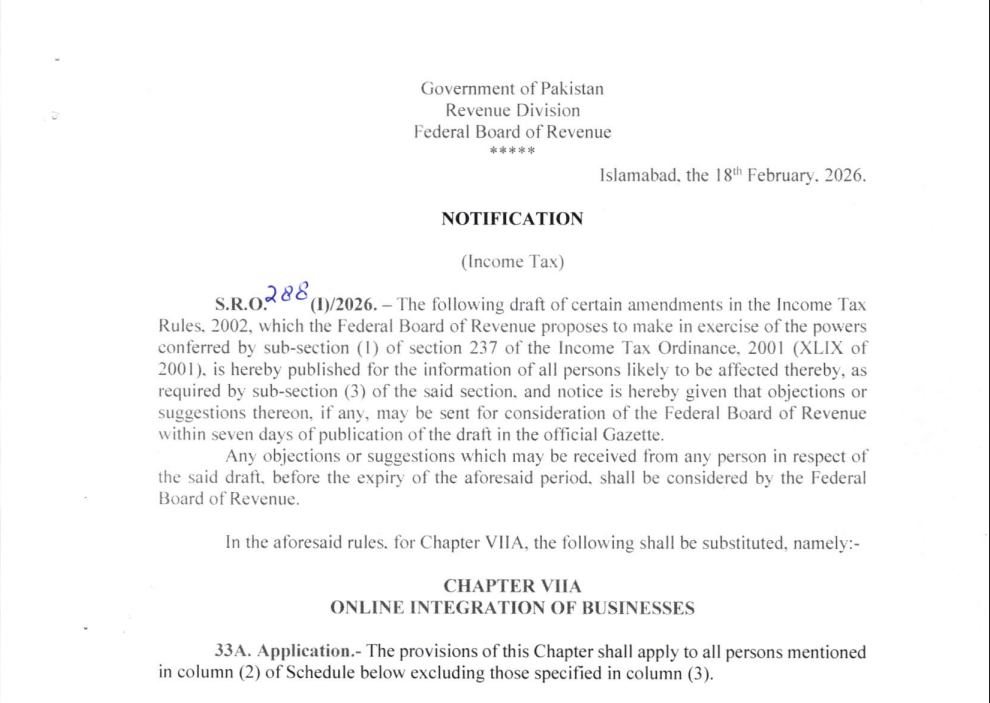
The Federal Board of Revenue has officially introduced major amendments under SRO 237, inserting Chapter VIIA – Online Integration of Businesses into the Income Tax Rules. This is not just another notification. This is a full digital transformation of how businesses in Pakistan must issue invoices, report sales, and connect with FBR in real time. If your business falls in the notified categories, compliance is mandatory. Let’s break down everything clearly so you understand what SRO 237 requires, who it applies to, and what happens if you ignore it.
What Is FBR Digital Invoicing?
FBR Digital Invoicing is a system where your business invoices are:
• Generated electronically
• Connected directly with FBR
• Issued with a unique QR code
• Recorded in real time
This means every sale you make is digitally reported to FBR through your POS or ERP system.
It replaces manual billing and simple receipt printing with a fully traceable system.
What Does SRO 237 Require?
SRO 237 is a draft amendment issued by the Government of Pakistan through the Revenue Division and FBR under Section 237 of the Income Tax Ordinance 2001. It introduces Chapter VIIA – Online Integration of Businesses, which makes it compulsory for notified businesses to fbr . This system is called Online Integration. Businesses covered under this rule are called Integrated Enterprises. According to SRO 237, businesses falling under notified categories must:
1. Register with FBR (If Applicable)
If your business meets the defined criteria, you must ensure proper FBR registration.
2. Integrate POS or ERP with FBR
Your billing system must connect directly with FBR’s Digital Invoicing System. Such as Sadahisab provides best POS software services in all over Pakistan with the best affordable price packages.
3. Issue QR Code Digital Invoices
Every invoice must contain a valid FBR QR code. Report all sales digitally
4. Display Official FBR QR Code Sticker
Businesses must place the official FBR QR sticker outside their shop to show compliance.
This sticker allows customers to verify whether your business is properly integrated with FBR. No sticker means non compliance risk.

Who Must Comply Under SRO 237? (Schedule Explained)
The Schedule attached to the SRO clearly defines which businesses are required to integrate and which are excluded.
This list is very specific. If your business falls into any of these categories, compliance is not optional. Let’s go through them carefully so you can clearly understand where you stand.
1. Restaurants
All restaurants must integrate except those where air conditioning is not installed. Additionally, if a restaurant’s shop area is 1000 square feet or more, it falls under mandatory compliance. This applies whether you run a fine dining restaurant, fast food outlet, or a franchise branch. If customers dine in an air conditioned environment, digital invoicing is compulsory. FBR wants restaurant sales to be reported in real time to ensure transparency and prevent under reporting of revenue. To avoid penalties from FBR and strict action from PRA, restaurants must upgrade their systems. Learn more in our complete guide on Why Every Restaurant Needs a Restaurant Management POS System.

2. Hotels, Guest Houses & Marriage Halls
These businesses must comply if air conditioning is installed. This includes clubs and marquees. Even if you operate seasonally or host occasional events, integration is still required once you meet the criteria. Since these businesses handle high value bookings and event payments, FBR considers them important for digital monitoring.

3. Inter City Road Travel Services
Mandatory integration applies unless:
• The service is completely non air conditioned
• The fleet size is less than five vehicles
If your buses are air conditioned and you operate multiple vehicles, you must issue digital tickets with QR verification. This ensures passenger revenue is properly recorded and reported to the tax authorities.
4. Courier and Cargo Services
All courier and cargo service providers are required to integrate. There are no major exemptions for this category. Since courier companies process thousands of shipments daily, FBR requires full digital reporting of booking and delivery charges.

5. Beauty Parlours and Personal Care Services
This includes:
• Beauty parlours
• Slimming clinics
• Massage centres
• Pedicure centres
Exemption applies only if air conditioning is not installed. If your salon provides premium services in an air conditioned setup, you must generate QR coded invoices. These businesses often receive cash payments, so digital invoicing helps bring transparency into the system.

6. Medical Service Providers
Includes:
• Dentists
• Physiotherapists
• Plastic surgeons
• Hair transplant surgeons
• Veterinary doctors
Exempt only if consultation fee is less than Rs. 500. If your consultation or procedure fee exceeds this limit, integration becomes mandatory. High value private medical services are under strict monitoring to ensure proper income reporting.
7. Diagnostic Labs & Private Hospitals
Includes:
• Pathological labs
• X Ray
• CT Scan
• MRI
• Private hospitals and medical centers
These must integrate without exception. There is no exemption based on air conditioning or fee structure in this category. All patient billing must be digitally reported and connected directly with FBR systems.
8. Health Clubs & Gyms
Includes:
• Gyms
• Fitness centers
• Swimming pools
• Multipurpose clubs
• Private clubs such as gymkhanas
These are required to comply. Whether you charge monthly membership or yearly packages, every payment must go through the integrated system. This helps ensure proper reporting of subscription and membership revenue.

9. Photographers & Event Managers
Mandatory integration applies if event fee exceeds Rs. 50,000 per event. If you handle weddings, corporate shoots, or large events above this threshold, you must issue digital invoices. Since event payments are often large and paid in cash or bank transfer, FBR requires full digital tracking.
10. Chartered Accountants & Cost Accountants
As defined under respective professional laws, they must comply. Professional service providers are now part of the digital invoicing system. Audit fees, consultancy charges, and retainership payments must all be reported through integrated systems.
11. Retailers
Retailers must comply if they fall into any of the following categories:
• Part of a national or international chain
• Located in an air conditioned shopping mall or plaza
• Annual electricity bill exceeds Rs. 1,200,000
• Wholesaler cum retailer
• Shop area is 1000 square feet or more
If none of the above apply, retailer may be excluded. Large retailers and branded stores are the main focus under this rule. FBR is targeting high volume retail businesses to ensure every sale is digitally recorded.
12. Foreign Exchange Dealers
Exchange companies must comply. All currency exchange transactions must be digitally invoiced and reported. Since foreign exchange involves high value transactions, strict digital monitoring is mandatory.
13. Private Schools & Educational Institutes
Includes:
• Schools
• Colleges
• Universities
• Vocational institutes
Exempt only if monthly fee per student is less than Rs. 1000. If your institution charges more than this amount, digital invoicing is required for fee collection. Tuition fees, admission fees, and other charges must be recorded through an integrated system.

What Does Online Integration Actually Require?
Under Rule 33B, an integrated enterprise must:
• Install electronic invoicing hardware and software
• Connect POS or ERP with FBR computerized system
• Issue invoices only through integrated machines
• Generate digital signature
• Transmit invoice data securely to FBR
• Receive a unique FBR invoice number
• Generate and print QR code on receipt
• Record all modifications and cancellations
• Perform daily, weekly and monthly closing
Manual billing is no longer allowed once integration applies.
Mandatory QR Code and Signboard Display
Every integrated enterprise must:
• Display FBR official logo
• Display “Integrated with FBR” signboard
• Display registered POS software number
This must be prominently visible at each outlet. Customers must be able to verify invoices through FBR’s verification system.
Real Time Invoice Reporting & 6 Year Record Retention
Every taxable supply must generate a real time verifiable electronic invoice.
Records must be:
• Stored electronically
• Retained for six years
• Reproducible during audit
Debit notes and credit notes must also be issued electronically. Online sales platforms must automatically generate invoices and report them.
Offline Mode & Internet Failure Rules
If internet or power fails:
• Invoice must clearly show it was issued in offline mode
• Data must be uploaded within 24 hours after restoration
Failure to upload can result in penalties.
CCTV & Monitoring Requirements
FBR may require:
• CCTV recording at points of sale
• Retention of footage for at least one month
• Submission of footage upon demand
This strengthens enforcement.
Audit & Enforcement Powers
Under Rule 33E and 33Y:
• Officers of Inland Revenue may visit premises
• They may verify real time integration
• They can compute tax on unreported sales
• Enforcement squads may conduct checks
Non integrated sales can result in tax recovery and penalties.
Penalties for Non Compliance
Under Rule 33H:
If a business:
• Tampers with the system
• Makes sales outside integrated system
• Violates any provision
It will face penalties under Section 182 of the Ordinance.
Additional restrictions and enforcement actions may apply.
Extension of Time for Integration
Commissioner Inland Revenue may grant extension up to 60 days in total.
However, businesses must continue issuing paper invoices until integration is completed. Extension is not automatic. It must be approved.
Licensed Integrators & PRAL
Only licensed software integrators can perform integration.
PRAL may act as licensed integrator and may provide:
• Free integration services
• Free downloadable invoicing software
License validity is five years and non transferable.
Why This Is a Major Shift for Businesses
This is more than compliance.
It is a complete digital monitoring system where:
• Every invoice is tracked
• Every sale is reported
• Every outlet is monitored
FBR is building a real time tax enforcement ecosystem. Ignoring this system is risky.
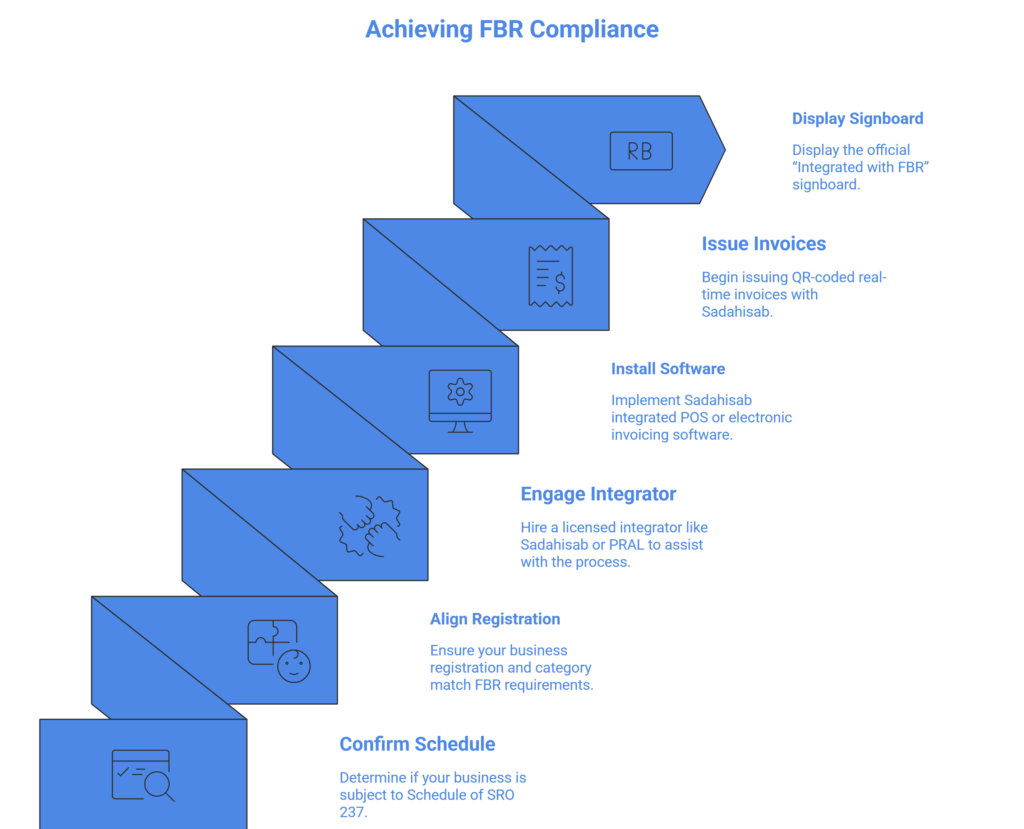
How to Become Compliant Step by Step
Step 1
Confirm if your business falls under Schedule of SRO 237.
Step 2
Ensure registration and category alignment with FBR.
Step 3
Engage a licensed integrator or PRAL.
Step 4
Install integrated POS or electronic invoicing software.
Step 5
Start issuing QR coded real time invoices.
Step 6
Display official “Integrated with FBR” signboard.
Conclusion
SRO 237 has reshaped the compliance framework in Pakistan. If your business is listed in the Schedule, integration is mandatory. This system ensures transparency, tax compliance, and digital traceability. The sooner you integrate, the safer your business will be from penalties, audits, and enforcement actions. Act now. Stay compliant. Protect your business. And integrate your business using sadahisab POS software that are available in all over Pakistan at affordable prices. Don’t wait just call Now!
Faqs
Q1: Is SRO 237 applicable to all businesses?
A. No. It applies only to businesses listed in the Schedule with specific conditions and exclusions.
Q2: How long must invoices be stored?
A. Electronic invoices must be retained for six years.
Q3: What happens if sales are made without QR code?
A. FBR can compute tax on unreported sales and impose penalties.
Q4: Can internet failure excuse non reporting?
A. Only temporarily. Offline invoices must be uploaded within 24 hours.
Q5: Can any software company integrate my POS?
A. No. Only licensed integrators approved by FBR or PRAL can perform integration.